How to Choose an EV for Commuting (2026): A 7-Step Checklist With Real Numbers
For most commuters, range is not the problem; charging access and efficiency are. A good rule: pick an EV whose EPA range is at least three times your daily round trip, then compare efficiency, because 24 vs 40 kWh per 100 miles is a $30–$90 monthly difference. Here is the full checklist.

Most EV shopping starts on a trim page, comparing range numbers. For a commuter that is backwards. Range is rarely what goes wrong; charging access and the monthly bill are. This checklist puts the decisions in the order that actually matters:
- Where you will charge (decides whether an EV saves money at all)
- Efficiency (decides your monthly bill)
- Insurance quote (can swing $1,000+ a year between models)
- Range (rarely the constraint for commuting, except in cold climates)
The rule of thumb for range: EPA range of at least 3× your typical daily round trip. Almost every new EV clears that for normal commutes.
Illustration (AI-generated).
Step 1: Measure your real driving
Use two weeks of real data, not a guess. Your phone’s location history, a fuel log, or the trip meter all work. Write down:
- Typical daily round trip (most days)
- Longest regular day (the day with a gym, school pickup, and a store run)
- Monthly total miles
- Your longest trip in the past year, and how often you take trips like it
The national pattern: a 30-mile round trip five days a week, plus about 50 miles of weekend errands, adds up to about 200 miles a week. That is the default in our EV charging cost calculator.
Step 2: Confirm where you will charge
This is the step that decides everything else. Monthly charging cost for 1,000 miles in a typical electric crossover:
| Where you charge | Monthly cost |
|---|---|
| Home, US average rate (18.3¢/kWh) | ~$62 |
| Home, off-peak EV rate (~12¢/kWh) | ~$40 |
| Free workplace charging | $0 |
| DC fast charging only ($0.55/kWh) | ~$175 |
If fast charging is your only option, a hybrid is usually cheaper to fuel. Read the guide that matches your situation before you shop:
- House with a garage or driveway: Level 2 installation cost. You may not even need Level 2, since a regular outlet adds about 40 miles overnight.
- Renter or condo owner: apartment EV charging
- Chargers at work: workplace EV charging
Step 3: Set a range target with the 3× rule
| Typical daily round trip | Minimum EPA range (3×) | Notes |
|---|---|---|
| 20 miles | 60+ miles | Any EV works. Level 1 home charging is likely enough. |
| 40 miles | 120+ miles | Any new EV works. |
| 60 miles | 180+ miles | Look for 250+ in cold climates. |
| 80+ miles | 240+ miles | Prioritize efficiency and Level 2 at home or work. |
Why 3×: you rarely charge to 100% daily, highway driving uses more energy than the EPA combined rating suggests, the battery loses a few percent over the years, and cold weather cuts range significantly. In AAA testing at 20°F with the heater on, EVs lost an average of 41% of their range.
If you live somewhere cold:
- Ask whether the exact trim has a heat pump, which uses much less energy for cabin heat
- Use preconditioning while plugged in, so the battery and cabin warm up on grid power
- Plan on more frequent charging, and on slower fast charging when the battery is cold
Step 4: Compare efficiency, not just battery size
Efficiency is listed on fueleconomy.gov as kWh per 100 miles. Lower is better. It sets your monthly bill:
| Efficiency | Example type | 1,000 mi/month at home (18.3¢) | 1,000 mi/month on DC fast ($0.55) |
|---|---|---|---|
| 24 kWh/100 mi | Efficient sedan (e.g. Tesla Model 3 RWD) | ~$49 | ~$139 |
| 30 kWh/100 mi | Typical compact crossover | ~$61 | ~$174 |
| 40 kWh/100 mi | Large SUV or pickup | ~$81 | ~$232 |
A bigger battery adds range but also weight and cost. For commuting, an efficient mid-size battery usually beats a huge pack.

Illustration (AI-generated). Write down your commute numbers before opening trim pages.
Step 5: Get insurance quotes for your top three
EV full-coverage insurance averages about $3,281 a year (MoneyGeek, 2026), but the spread between models is huge. Some EVs, such as the Hyundai Ioniq 5, are quoted under $2,000 a year, while some luxury and Tesla models exceed $4,000.
Get real quotes for your address and driving record for each finalist before you test drive. The difference can outweigh years of fuel savings.
Step 6: Check charging speed and plug type
This matters for road trips and for anyone who uses public charging:
- Plug type: many non-Tesla EVs now come with or support the NACS (Tesla) port, which opens up the Supercharger network. Confirm adapter support for the exact model year.
- DC fast charging time: look for a published 10–80% time. Under 30 minutes is good for a commuter who occasionally road-trips.
- Onboard AC charger: 7.2–11 kW is plenty for home Level 2. You do not need to pay for a bigger circuit than the car can use.
- Stations near you: search your commute area on the AFDC station locator.
Step 7: Test drive your actual commute
A dealership loop tells you little. Ask to drive:
- The highway stretch of your commute, at your normal speed
- Stop-and-go traffic, to try one-pedal driving and regenerative braking
- Your parking situation, such as a tight garage, a street spot, or a steep driveway
While driving, check seat comfort for a long commute, visibility, road noise, and whether the screen controls are easy to use without looking away from the road.
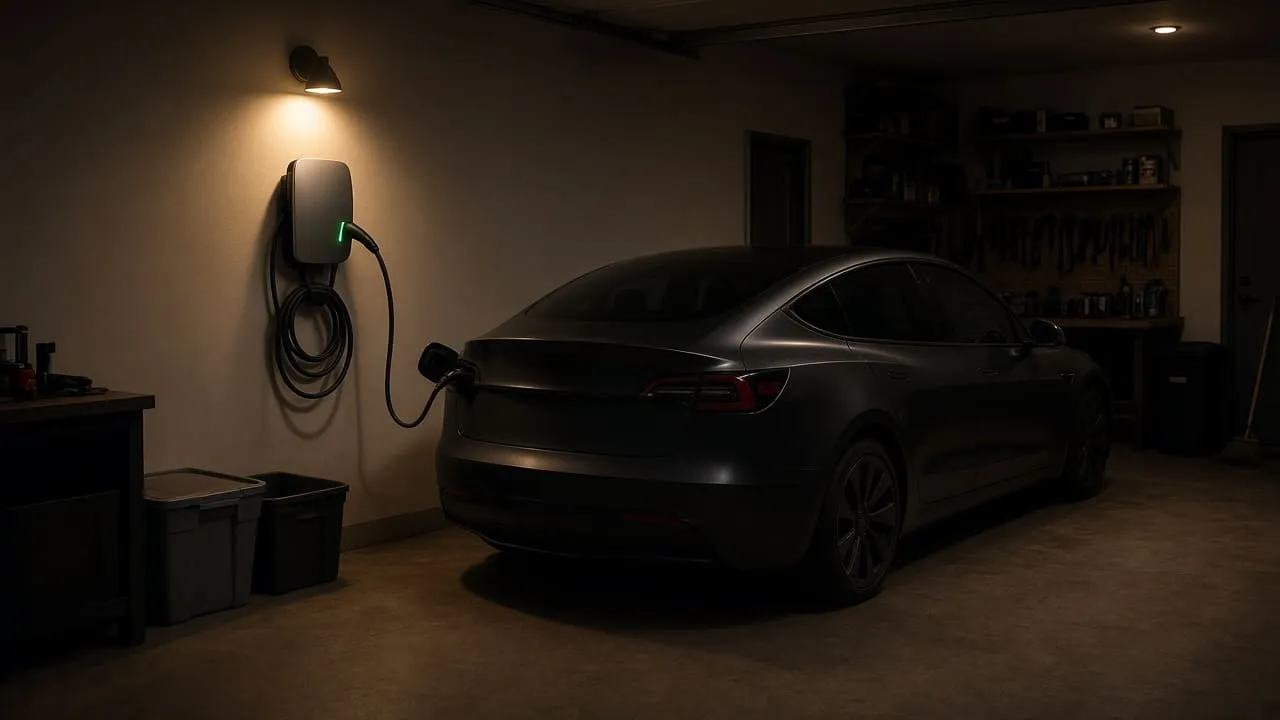
Illustration (AI-generated). Charging overnight at home is the EV’s biggest everyday advantage.
Then compare the 5-year cost
With your finalists narrowed down, compare:
| Line | How to estimate |
|---|---|
| Price after rebates | Out-the-door quote minus any state rebate. See state EV incentives. No federal credit in 2026. |
| Charging | Your monthly cost from Step 2 or 4 × 60 |
| Insurance | Your quote × 5 |
| Tires | EVs are heavy and wear tires faster. Budget for at least one set over five years. |
| Value after 5 years | EVs depreciate quickly. A lease can shift that risk. See lease vs buy an EV. |
Still unsure whether to go fully electric? Run the EV vs hybrid comparison. If you are shopping used, use the used Model 3 and EV6 inspection checklist.
Common mistakes
- Buying the biggest battery “just in case” when your commute is 30 miles. You pay for range you rarely use.
- Assuming public fast charging is cheap. At $0.55/kWh it costs more per mile than a good hybrid.
- Skipping the insurance quote until after signing.
- Ignoring winter if you live in a cold state. Size range for January, not June.
- Planning around a federal credit. It ended September 30, 2025.
- Doing the steps out of order. Charging first, efficiency second, insurance third. If EPA range is three times your daily round trip, range takes care of itself.
Sources
- FuelEconomy.gov — Compare electric vehicles (kWh/100 mi, range): https://www.fueleconomy.gov/feg/evsbs.shtml
- FuelEconomy.gov — 2026 Tesla efficiency ratings: https://fueleconomy.gov/Feg/bymake/Tesla2026.shtml
- AAA — Cold weather reduces electric vehicle range: https://newsroom.aaa.com/2019/02/cold-weather-reduces-electric-vehicle-range/
- EIA — Average residential electricity price, Table 5.3: https://www.eia.gov/electricity/monthly/epm_table_grapher.php?t=table_5_03
- DCFC Tracker — US DC fast charging prices (Oct 2026): https://dcfctracker.com/ev-pricing
- MoneyGeek — EV insurance costs 2026: https://www.moneygeek.com/insurance/auto/insuring-an-electric-vehicle/
- AFDC — Station locator: https://afdc.energy.gov/stations
Prices checked October 2026. Rerun the numbers with your own electricity rate and insurance quotes.
FAQ
How much range do I need in an EV for commuting?
A practical rule is EPA range of at least three times your typical daily round trip. That leaves room for cold weather, highway speeds, battery aging, and not charging to 100% every night. A 40-mile round trip needs about 120 miles of EPA range, which almost every new EV exceeds. Charging access usually matters more than range.
How much does cold weather reduce EV range?
AAA testing found that at 20°F with the heater running, the EVs tested lost an average of 41% of their range. Losses are smaller with a heat pump, preconditioning while plugged in, and shorter trips. If you live somewhere cold, size your range for winter and look for a heat pump.
What is the most important thing to check before buying an EV?
Where you will charge. With home or workplace charging, an EV usually costs $50–$80 a month to fuel for 1,000 miles. Without it, relying on DC fast charging at the October 2026 US average of $0.55/kWh can cost $140–$230, which is more than many hybrids cost in gas.
Does EV efficiency really matter if electricity is cheap?
Yes. An efficient sedan at about 24 kWh/100 miles costs about $49 a month to charge at home for 1,000 miles, versus about $81 for a large SUV at 40 kWh/100 miles. On public fast charging the gap grows to about $90 a month.