Apartment EV Charging in 2026: Renter Options Ranked by Monthly Cost
Charging at your own parking spot costs about $62 a month for 1,000 miles. Relying only on DC fast chargers costs about $175, which is more than fueling a Prius. Here are your options as a renter or condo owner, ranked by cost, plus the states where your landlord has to say yes.
Picture two renters in the same complex. Same electric crossover, same 30-mile round trip, about 1,000 miles a month. One has a 120V outlet within reach of her assigned spot and pays the landlord for the power. The other has no plug and fills up at a DC fast charger on Saturdays.
The first spends about $62 a month. The second spends about $175, more than a Prius owner pays for gas. Same car, same miles, $113 a month apart. For renters, where you charge decides whether an EV saves money at all.
What 1,000 miles costs, by where you plug in
Assumes a typical electric crossover at 3.3 miles per kWh:
| How you charge | Price assumption | Cost for 1,000 miles |
|---|---|---|
| Free workplace or retail Level 2 | $0 | $0 |
| Your own parking spot, home rate | 18.3¢/kWh (EIA US average, June 2026) | ~$62 |
| Workplace Level 2, paid | ~$0.25/kWh | ~$84 |
| Public Level 2 (garages, retail) | ~$0.30/kWh | ~$101 |
| Tesla Supercharger, member rate | ~$0.43/kWh | ~$138 |
| DC fast charging only, US average | ~$0.55/kWh | ~$175 |
| Toyota Prius (57 mpg), for comparison | $4.37/gal | ~$77 |
| 30-mpg gas car, for comparison | $4.37/gal | ~$146 |
Public DC prices are from DCFC Tracker’s October 5, 2026 national average. Gas is the AAA national average on the same date.
What the table means: if a public fast charger is your only option, an EV costs more to fuel than a good hybrid. The EV starts winning once you have a regular slow charging spot: at your building, at work, or somewhere you already park for hours.
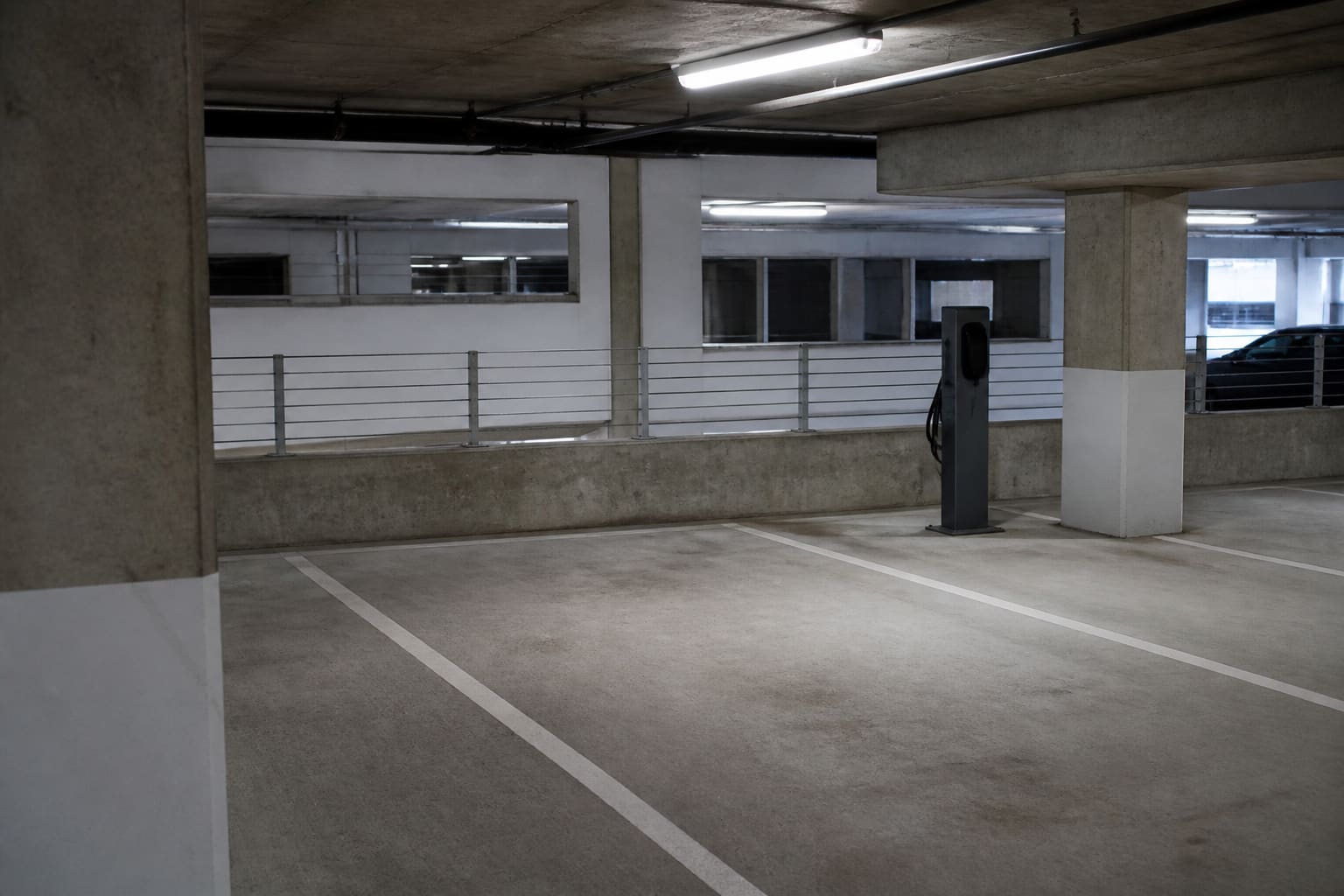
Illustration (AI-generated). Not a specific building.
Your options, ranked
1. A plug at your own parking spot (best)
Even a plain 120V outlet changes the math. Level 1 charging adds about 4 miles per hour, roughly 40 miles over a 10-hour night. That covers a typical 30-mile round-trip commute.
If there is an outlet within reach of your assigned spot, ask the property manager if you can use it, and offer to pay for the electricity. If there is no outlet, ask whether they would let a licensed electrician add one at your cost. A new outlet near a panel typically costs $300–$800. Long runs across a parking garage cost more.
2. Workplace charging
About half of employees in a 2025 Plug In America survey said they have charging at work. Free workplace charging is common, and paid programs usually bill $0.15–$0.35/kWh, well below fast charging. An 8-hour shift on a standard Level 2 port can add 150+ miles.
The catch is that workplace charging can disappear when policy changes or the lot gets crowded. See workplace EV charging for how to test it before you buy.
3. Public Level 2 where you already park
Grocery stores, gyms, city garages, and libraries often have Level 2 chargers at $0.20–$0.40/kWh, and some are free. Two to three hours twice a week can cover a commute. Find stations near home with the AFDC station locator or PlugShare, then check the price in the network’s app.
4. DC fast charging as your main source (most expensive)
Fast charging works for road trips and emergencies. As your only source, it is the most expensive way to run an EV and adds a weekly 30–45 minute errand. Tesla drivers pay less (about $0.43/kWh member rate vs $0.63 for non-members), and non-Tesla drivers can pay $12.99/month for the member rate. That only pays off if you fast charge often.
Illustration (AI-generated). Fast charging is a road-trip tool, not a cheap daily refill.
Right-to-charge laws: where your landlord has to say yes
Most “right-to-charge” laws protect condo and HOA owners, not renters. According to Plug In America, only California, Colorado, Connecticut, Illinois, Oregon, and Washington, D.C. extend protections to renters.
| Where | Who is protected | Key details |
|---|---|---|
| California (Civ. Code §1947.6) | Renters and condo owners | Landlord must approve a written request for an assigned space. Exemptions include buildings where 10%+ of spaces already have chargers. Tenant pays and may need insurance. |
| Oregon (ORS 90.462) | Renters, HOA, and condo owners | Landlord must approve a complete application within 60 days. Tenant pays installation and electricity, and must use a licensed installer. |
| Colorado, Connecticut, Illinois, D.C. | Renters (limits vary) and owners | Check the statute text through Plug In America’s state summaries. |
| About 10 more states, including FL, MD, MA, NJ, NY, TX, VA, WA | Mainly condo and HOA owners | Boards cannot unreasonably deny, but can require insurance, a licensed electrician, and proof of electrical capacity. |
Even where the law protects you, it does not force the landlord to give you a parking space, and you usually pay for everything. Outside these states, it is a negotiation.
How to ask your landlord (and get a yes)
Make it easy to approve. Put the request in writing and cover the questions a property manager will worry about:
- Location: your assigned space, and the nearest electrical panel or outlet
- What you want: use of an existing 120V outlet, or a new 240V circuit installed by a licensed, insured electrician with a permit
- Who pays: you cover installation, and propose how you will pay for electricity (a submeter, a per-kWh rate, or a flat monthly fee)
- Liability: offer to add the landlord to your renter’s insurance as an additional insured
- Move-out: say whether you will remove the charger or leave it, and who owns it
Pricing the electricity fairly: 1,000 miles a month uses about 340 kWh, roughly $62 at the national average rate. A flat fee of $30–$60 is reasonable for a typical commute. If the landlord asks for much more, propose a submeter so you pay for what you use.
Before you put down a deposit
Run this check before buying an EV as a renter:
- Do I have a regular charging spot I can use at least 3 nights or workdays a week?
- Is there a public Level 2 station within a short walk of home or work?
- What would my monthly cost be? Use the table above or the EV charging cost calculator, and set the public charging share to match reality.
- If I move next year, will the new place have charging?
If the honest answer is “fast charging only,” consider a hybrid or plug-in hybrid until your parking situation changes. Our EV vs hybrid comparison runs those numbers side by side.
Picking an EV when you charge away from home
- Efficiency matters more than battery size. A Tesla Model 3 uses about 24–26 kWh per 100 miles (EPA), while large electric SUVs use 40+. At public prices that gap is real money every month.
- Charging speed matters for public sessions. A car that charges 10–80% in under 30 minutes wastes less of your evening.
- Plug type: Many non-Tesla EVs now use the NACS (Tesla) port or an adapter, which opens up Supercharger access. Confirm adapter support for the exact model year.
Back to the two renters: the one with the outlet is the one an EV makes sense for. If you are the other one, the most valuable thing you can do before buying is to turn yourself into the first, through your landlord, your employer, or a Level 2 station where you already park.
References
- Right-to-charge laws by state: Plug In America
- Statute text: California Civil Code §1947.6 and Oregon ORS 90.462
- Public DC fast charging price, national average on Oct. 5, 2026: DCFC Tracker
- Home electricity rate, June 2026: EIA Table 5.3
- Prius fuel economy: FuelEconomy.gov
- Finding stations near you: AFDC station locator
Prices checked October 2026. Not legal advice. Statutes change; read your state’s current text before relying on it.
FAQ
Can I own an EV if I live in an apartment with no charger?
Yes, but check the math first. With workplace or nearby Level 2 charging, an EV usually costs $0–$100 a month to charge for 1,000 miles. If DC fast charging is your only option, expect about $175 a month at the October 2026 US average of $0.55/kWh, which is more than a 57-mpg hybrid costs in gas.
Does my landlord have to let me install an EV charger?
Only in a few places. California, Colorado, Connecticut, Illinois, Oregon, and Washington, D.C. extend right-to-charge protections to renters. In those places the tenant typically pays for installation, electricity, and insurance, and must use a licensed electrician. Most other states' laws protect condo and HOA owners only.
Is it safe to charge from a regular outlet with an extension cord?
Do not use a household extension cord. Most automakers warn against it because the cord can overheat during hours of continuous charging. If a 120V outlet is within reach of your spot, plug the car's charging cable directly into it, or ask the property to add an outlet.
What is a fair monthly fee to pay my landlord for charging?
Base it on energy used. Driving 1,000 miles a month in a typical electric crossover uses about 340 kWh from the wall, which is about $62 at the June 2026 US average residential rate of 18.3¢/kWh. A flat fee of $30–$60 is in a reasonable range for a typical commute. Above that, ask for a submeter or a per-kWh rate.