Workplace EV Charging in 2026: Cost, Miles per Shift, and Reliability
One 8-hour workday on a standard Level 2 port adds about 150–180 miles, which is a full week of a typical commute. Workplace charging is free at many employers and usually $0.15–$0.35/kWh where it is paid. Here is how to tell if it is reliable enough to buy an EV around.
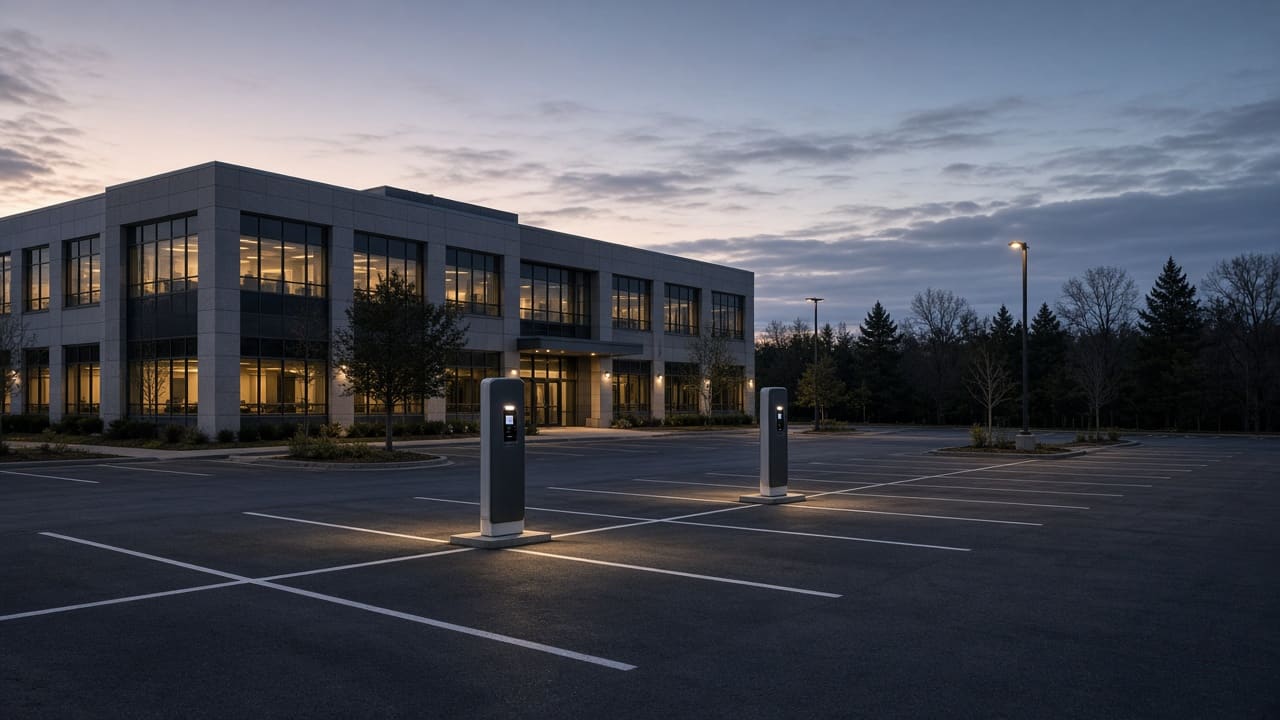
Your office lot has a row of chargers, and you are wondering whether that is enough to buy an EV without charging at home. Often it is. One full workday on a standard Level 2 port adds about 150–180 miles, roughly a week of commuting. Whether you can count on it is the real question, and the sections below are the questions to ask, in the order we would ask them.
- Free is common. In an Ipsos survey of US workers who have chargers at work, 40% said charging is free, 28% pay, and 33% did not know.
- Paid programs are cheap. Expect about $0.15–$0.35/kWh, or about $1 an hour, compared with a US average of $0.55/kWh for DC fast charging (DCFC Tracker, October 2026).
- The risk is reliability. Policies change, lots fill up, and remote-work weeks happen. Test it before you buy.
How far does one workday get me?
Workplace chargers are usually Level 2 units delivering 6.6–7.7 kW. Here is what that means for a typical electric crossover (3.3 miles per kWh, 90% charging efficiency):
| Session length | 6.6 kW port | 7.7 kW port | Enough for |
|---|---|---|---|
| 2 hours | ~40 mi | ~45 mi | Today’s commute plus errands |
| 4 hours | ~80 mi | ~90 mi | 2–3 days of a 30-mile commute |
| 8 hours | ~155 mi | ~180 mi | A full week of a 30-mile commute |
A 30-mile round trip five days a week is 150 miles. Two 4-hour sessions or one full-day session covers it.
Some employers only offer Level 1 (standard 120V outlets) in the parking lot. That is still useful: 8 hours on Level 1 adds about 30–35 miles, roughly one day’s commute.

Illustration (AI-generated). The chargers in the lot are not the same as an access policy.
What will I pay?
For 1,000 miles a month in a typical crossover (about 340 kWh from the charger):
| Workplace pricing | Monthly cost | vs DC fast only ($0.55/kWh) |
|---|---|---|
| Free | $0 | saves ~$175 |
| $0.15/kWh | ~$51 | saves ~$124 |
| $0.25/kWh | ~$84 | saves ~$91 |
| $0.35/kWh | ~$118 | saves ~$57 |
| Home charging at the US average (18.3¢/kWh) | ~$62 | saves ~$113 |
Watch for idle fees. Charging networks let employers add a per-hour or per-minute fee once your car is full but still plugged in. Over a long workday that can cost more than the electricity, so check the price after the session ends, not just the price per kWh.
What if there are more EVs than ports?
The common worry is “there are only six chargers and twenty EVs.” Whether that works depends almost entirely on time limits:
- With a 4-hour limit and a midday swap: 6 ports × 2 sessions × 5 days = 60 sessions a week. Shared among 20 drivers, that is 3 sessions each, about 270 miles a week per driver. That is plenty.
- With no limit: the first six cars sit all day, and the other fourteen drivers get nothing.
So before you buy, ask whether there is a time limit and whether people actually follow it.
What should I ask HR or facilities?
Get the answers in writing, such as an email, a policy page, or the charging app’s terms:
- Who can use the chargers? All employees, a waitlist, or only certain buildings or badges?
- How many ports, and how many EV drivers? Ask for the current count, not the plan.
- Price: per kWh, per hour, or free? Is there an idle fee after charging finishes?
- Time limits and swaps: Is there a maximum session, and an app that tells you when a port opens?
- Access hours: Can you charge on weekends or late shifts?
- Future plans: Are chargers being added, removed, or switched from free to paid?
How do I know it will work for me?
If you have a colleague with an EV, ask how often they actually get a port. If you can, walk the lot at 8 a.m., noon, and 3 p.m. for two weeks and note how many ports are free. Some networks show port availability in their app, which is even easier.
Then check your numbers in the EV charging cost calculator: enter your commute and set the public charging share to cover the days you cannot charge at work.

Illustration (AI-generated). Set up app access before the car arrives.
What about remote-work weeks and holidays?
Workplace charging fails at predictable times: remote-work weeks, holidays, vacations, the week facilities repaves the lot. Have at least one backup:
- A home outlet. Even Level 1 adds about 40 miles overnight. Renters can start with our apartment EV charging guide.
- A public Level 2 station near home or a place you already go, such as a grocery store or gym.
- Fast charging for emergencies. It is expensive as a habit, but fine once in a while.
If home charging is possible, compare its cost with what you would pay at work. Our Level 2 installation cost guide has the numbers.
How do I keep the perk from disappearing?
Free workplace charging disappears fastest when a few drivers abuse it:
- Move your car when the session ends or the time limit is up.
- Do not unplug someone else’s car unless the site’s policy explicitly allows it.
- Use the waitlist or a team chat channel to coordinate swaps.
- Report broken ports to facilities quickly, so they get fixed before management decides the program is not worth it.
So, can I skip home charging?
Yes, if three things are true: you get two or more sessions a week, the policy is in writing, and you have a backup for weeks you are not in the office. Get all three before you buy, not after.
Sources. Free-vs-paid survey: Ipsos EV topline. Share of workers with charging at work: Plug In America 2025 survey. Program design and idle fees: ChargePoint employer guide and AFDC workplace charging. Prices: DCFC Tracker, Oct. 5, 2026 and EIA Table 5.3.
Prices checked October 2026. Charging policies are set by each employer and can change without notice.
FAQ
Is workplace EV charging usually free?
Often. In an Ipsos survey of US workers with chargers at work, 40% said charging was free, 28% said they paid, and 33% did not know. Paid programs typically bill $0.15–$0.35/kWh or about $1 an hour, which is far below the US average of $0.55/kWh for DC fast charging.
Can I rely on workplace charging instead of installing a home charger?
Yes, if you can count on at least two sessions a week, you have a backup for remote-work weeks and holidays, and the employer's policy is written down. If any of those is missing, plan on a home outlet or a nearby public Level 2 station as well.